
Remembering Our War Heroes
Lance Corporal Frederick William Kingsland
24 June 1895 – 2 February 1917
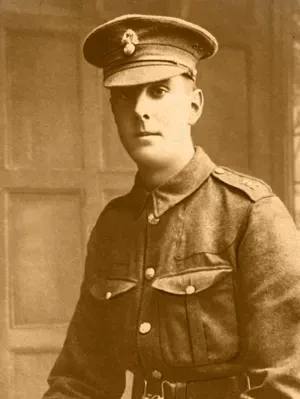 Lance Corporal Frederick William Kingsland was born on 24 June 1895 in Uckfield, Sussex, the son of William Kelso Kingsland and Elizabeth Kingsland (née Cox). He grew up within a close-knit Sussex family whose life was rooted in the villages of Uckfield and Crawley Down, places that would remain central to his identity and enduring remembrance.
During Frederick’s childhood and early adulthood, the Kingsland family lived at Rose Cottage, Crawley Down, a modest home where Frederick spent his formative years. It was from Rose Cottage that he left civilian life behind to serve his country. In recognition of his sacrifice, a blue plaque has been placed on Rose Cottage, commemorating Frederick William Kingsland and permanently marking his connection to the village that was his home.
As a young man, Frederick worked as an assistant grocer, as recorded in the 1911 census. Like countless others of his generation, his ordinary working life was interrupted by the outbreak of the First World War. When war came, Frederick volunteered for service, joining the British Army during the early years of the conflict.
He served with the Royal Fusiliers, attaining the rank of Lance Corporal in the 22nd Battalion, with the service number 150. His battalion was deployed to the Western Front, where it became engaged in some of the most intense and sustained fighting of the war. Frederick was among the young Sussex men who endured the hardships of trench warfare, sharing the dangers and privations faced daily by front-line infantry soldiers.
By 1916, his unit was involved in the devastating Somme campaign, where conditions were harsh and casualties severe. Frederick remained with his battalion through this period, demonstrating the quiet endurance characteristic of so many soldiers whose individual stories were seldom recorded in detail but whose service was vital.
On 2 February 1917, during ongoing operations in French Flanders, Lance Corporal Frederick William Kingsland was killed in action, aged 21. His death occurred at a time when the war continued to exact a heavy toll, even as hopes persisted at home that peace might soon follow.
Frederick was laid to rest in Courcelette British Cemetery on the Somme, a place of solemn remembrance situated on ground that had seen fierce fighting.
His grave is maintained in perpetuity by the Commonwealth War Graves Commission, ensuring that his sacrifice is formally and respectfully honoured.
One hundred years after his death, in 2017, Phillip Kingsland-Budd, Lynda Reace, and Jordan Reace travelled to France to visit Frederick’s grave and pay their respects on the centenary of his sacrifice. This act of remembrance stands as a powerful expression of enduring family connection, linking the present generation directly with Frederick’s life and service.
Frederick never married and left no children, but his memory has been carefully preserved through family remembrance, official records, the blue plaque at Rose Cottage in Crawley Down, and his marked grave in France. He is remembered not only as a soldier of the First World War, but as a son, a brother, and a young man whose life was shaped by duty and ended by war.
Frederick William Kingsland is remembered with honour, both at home in Sussex and on the battlefields of France.