
Remembering Our War Heroes
Corporal Frank Finden
6 December 1879 – 7 October 1916
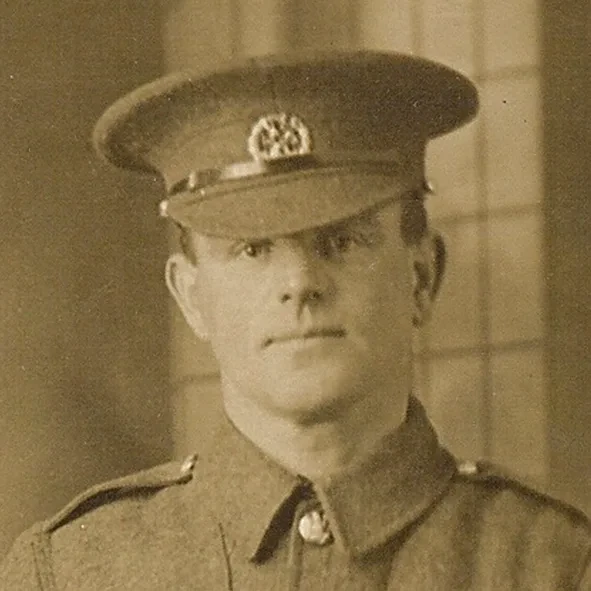 Frank Finden was born on 6 December 1879 and lived his adult life in the Portsmouth area, a community with long-standing military traditions. On 25 December 1907, he married Eleanor Elizabeth Ventham (known as Nellie), who had been born on 28 July 1883. The family home was at 13 South Street, Southsea, Portsmouth, where Frank assumed responsibility not only as husband but also as step-father to Eleanor Iola Jane Ventham, born 13 March 1904. Later pension records confirm that both his widow and step-daughter were formally recognised as his dependants.
During the First World War, Frank enlisted in the Hampshire Regiment, serving with the 15th (Service) Battalion, one of the so-called “Portsmouth Pals” battalions raised under Kitchener’s New Army scheme. Drawn largely from the local population, these units trained and served alongside neighbours, friends, and workmates. Frank’s service number was 15467, and he rose to the rank of Corporal, suggesting experience, reliability, and leadership within his unit.
Frank’s Medal Index Card records entitlement to the British War Medal and the Victory Medal only. The absence of a Star medal confirms that he did not enter an overseas theatre of war before 1916, placing his active service during the later and most intense phases of the conflict on the Western Front.
On 7 October 1916, Corporal Frank Finden was killed in action in France during the Battle of the Somme. While one document records a date of 4 October, the official records of the Commonwealth War Graves Commission and medal rolls confirm 7 October 1916 as the correct date of death. His sacrifice occurred during the fighting around Le Sars and the Butte de Warlencourt, some of the final objectives of the Somme offensive.
Frank was initially buried close to where he fell, in a battlefield grave at map reference 57c.M.11.d.15.90. In 1920, his remains were respectfully exhumed and reinterred at Warlencourt British Cemetery, Pas-de-Calais, France, where he now rests in Plot IV, Row G, Grave 28. After the war, his family received a Class IV pension totalling 20 shillings per week, effective 30 April 1917, allocated as 15 shillings to his widow and 5 shillings to the child, following the end of separation allowance payments.
The Somme and the Butte de Warlencourt: October 1916
The Battle of the Somme, begun on 1 July 1916, had by October become a grim struggle of attrition. Initial hopes of a breakthrough had faded, and the later stages of the battle focused on capturing a series of villages, ridges, and fortified positions that dominated the surrounding countryside. Among the most stubborn of these was the Butte de Warlencourt, a chalk mound heavily fortified by German defenders with trenches, dugouts, and machine‑gun positions.
On 7 October 1916, British forces launched renewed attacks in the area of Le Sars, a heavily damaged village near the Butte. Fighting took place over ground already shattered by months of shellfire, turning former fields into mud‑filled craters. Movement was slow, communications were difficult, and units often suffered heavy casualties simply attempting to reach their objectives under sustained artillery and machine‑gun fire.
It was during this brutal phase of the battle that Corporal Frank Finden lost his life. Like many men of the Pals battalions, he faced combat not only alongside fellow soldiers, but alongside men he had known in civilian life. The losses suffered during these October attacks were severe, and progress was measured in yards rather than miles.
Though the Somme offensive officially ended in November 1916, the cost was immense. Frank Finden’s death on 7 October places him among those who fell during the final, exhausting efforts of that campaign. His grave at Warlencourt now stands as a permanent reminder of the sacrifices made by the men of Portsmouth and the Hampshire Regiment during one of the most costly battles in British military history.