
Our Family History
Friends come and go, but relatives tend to accumulate.
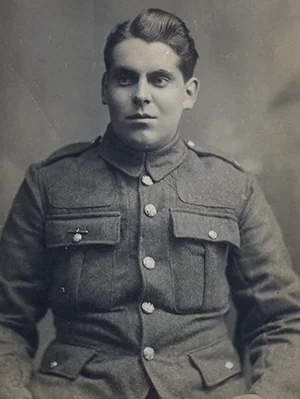
John Francis Budd (1894–1979)

From Rural Surrey to Prisoner of War

Chief Petty Officer Herbert John BudgenJohn Francis Budd lived a life deeply interwoven with the defining and tumultuous events of the early twentieth century. From a quiet, rural upbringing in the rolling hills of the Surrey countryside to the devastating, mud-slicked battlefields of the Western Front, John’s story is one of quiet resilience, remarkable survival, and an ultimate, understated return to civilian life.

Early Life and the Call to Arms
John Francis Budd was born on 9 November 1894 in the picturesque, historic village of Lingfield, Surrey. Growing up in the Sussex-Surrey borderlands during the twilight of the Edwardian era, his early life was shaped by the rhythms of a tight-knit rural community. Upon leaving school, John secured employment as a Grocer’s Assistant. In the early twentieth century, this was a respected and demanding trade. It required a meticulous eye for inventory, a welcoming demeanour for local shop patrons, and the physical stamina to handle heavy sacks of flour, oats, and dry goods delivered by horse-drawn wagons to the local storefronts.

This quiet, community-focused existence was shattered in August 1914 by the outbreak of the First World War. While many young men rushed to the colours in the initial wave of patriotic enthusiasm, John initially remained at his counter, supporting local commerce. However, by late 1915, the devastating toll of trench warfare on the Western Front forced the British government to take drastic measures to find fresh reinforcements. The "Lord Derby Scheme" was launched—a final, massive push for voluntary enlistment that placed intense moral pressure on eligible young men before outright conscription was introduced.

The call of duty, paired with the looming certainty of the draft, prompted a profound family decision. On 8 November 1915, just one day before John's 21st birthday, he and his brother Ralph walked side-by-side into the recruitment hub to volunteer together. It was a common sight across Britain at the time—brothers choosing to face the great unknown of the war as a united front.

Because they enlisted under the terms of the Derby Scheme, they officially deferred their immediate service until their specific age groups were called up. This explains why John returned to the market town of East Grinstead just over a week later, on 17 November 1915, to undergo his formal army medical examination. Stripped before the medical officer, his physical profile was meticulously logged onto his paperwork:


Official Physical Profile (17 November 1915)
  • Age: 21 years, 8 days
  • Height: 5 feet, 3½ inches
  • Chest Measurement: 31½ inches (fully expanded to 33½ inches)
  • Physical Development: Satisfactory
  • Marks/Distinctive Features: Small scar on the left side of his neck
  • Medical Fitness Classification: Fit for General Service

Though slight of build at just over five feet three inches, John was passed as thoroughly healthy and fit for front-line duty. On 23 November 1915, the bureaucratic process was finalised when he signed his formal attestation papers and swore his solemn Oath of Allegiance to King George V.

With the parchment signed, the young grocer's assistant was officially taken onto the strength of his regional regiment, the Royal Sussex Regiment, and issued his first military identity: service number G/8380. The apron was ultimately traded for the khaki uniform, and John’s journey into the crucible of the Great War—begun on that November day alongside his brother—had officially commenced.

The Machine Gun Corps: A Tactical Pivot
John’s tenure as a traditional infantryman was destined to be incredibly brief. The nature of trench warfare had changed drastically, and the British Army was rapidly expanding its newly formed tactical elite: the Machine Gun Corps (MGC). Nicknamed "The Suicide Club" due to the high casualty rates and the perilous nature of operating on the front line, the MGC required men of high intelligence, physical stamina, and mechanical aptitude to operate the heavy Vickers machine guns.

Recognizing these qualities in the young grocer's assistant, military authorities officially transferred John to the Machine Gun Corps on 7 April 1916. Upon his transfer, he was stripped of his infantry designation and handed his permanent wartime service identity: number 30428.

While subsequent family lore and early accounts mistakenly suggested John spent the bulk of the war guarding the English coastline, his official "Military History Sheet" tells a far more immediate and active story. He spent exactly 199 days training at "Home" in England, mastering the complex mechanisms, tactical positioning, and rapid-fire capabilities of the Vickers gun.

His training concluded swiftly, and on 10 June 1916, John boarded a troopship bound for France. He was arriving just as the British Army was preparing for the monumental, catastrophic clash on the Somme.

Service on the Western Front
Upon setting foot on French soil, John was posted to the 18th Company of the Machine Gun Corps. These independent machine gun companies were tactically attached to infantry brigades, tasked with providing devastating defensive fire and covering elements during major advances.

John adapted exceptionally well to the immense psychological and physical pressures of life on the Western Front. His discipline and dependability did not go unnoticed by his commanding officers. On 22 May 1916—just prior to his overseas deployment—he had been appointed to the rank of Unpaid Lance Corporal. This role placed him in a position of direct battlefield leadership, responsible for overseeing a specific gun section and ensuring his crew kept their weapon firing under intense enemy artillery barrages.

For nearly two gruelling years, John survived the relentless rotation of trench life: the biting winter mud, the constant threat of sniper fire, gas attacks, and the devastating German artillery shells. He held his ground across various sectors of the British line as the war ground onward through 1916 and 1917.

The Kaiserschlacht and Capture at St. Quentin
By early 1918, the British Army underwent a major structural reorganisation. The independent machine gun companies were consolidated into larger, more cohesive battalions. Consequently, John’s unit was formally absorbed into the 61st Battalion, Machine Gun Corps.

Almost immediately after this restructuring, the battalion found itself directly in the path of one of the most violent, terrifying military operations in human history: the German Spring Offensive, or Kaiserschlacht (The Kaiser's Battle).

On 21 March 1918, the German Empire launched a massive, sudden bombardment of high explosives and gas shells along a 50-mile front. Supported by elite, fast-moving Stoßtruppen (Stormtroopers), the Germans succeeded in breaking through the heavily depleted Allied lines. The 61st Battalion fought tenaciously, utilising their Vickers guns to lay down desperate defensive barrages, but the sheer velocity of the German advance quickly left forward units completely isolated and surrounded.

Amidst the catastrophic chaos of the fighting retreat near St. Quentin, on 22 March 1918—the second day of the offensive—Lance Corporal John Francis Budd was captured by enemy forces. Back home in England, his name was officially logged as "Missing in Action." For his anxious family, a painful, agonizing period of total silence began, with no knowledge of whether he was dead or alive.

Behind Barbed Wire: Captivity in Stendal
John survived the terrifying immediate aftermath of his capture, a period when many prisoners were exposed to retaliatory violence or forced to work under fire. He was processed by the Imperial German Army, and his details were meticulously recorded on German prisoner-of-war documents (Fiche V 35).

He was transported deep into the German interior, eventually arriving at Kriegsgefangenenlager Stendal (Stendal POW Camp), situated north of Magdeburg.

Life in Stendal during the final year of the war was an exercise in pure survival. Because of the highly effective Allied naval blockade, Germany was gripped by severe shortages of food, medicine, and fuel. Rations within the camp were abysmal, often consisting of little more than watery turnip soup and sawdust-adulterated black bread. Disease, particularly typhus and the early waves of the Spanish Flu, was a constant shadow.

Like thousands of his comrades, John relied heavily on the arrival of international Red Cross food parcels to stave off malnutrition. For eight long months, he endured the bleak monotony, hunger, and vulnerability of captivity behind barbed wire, watching from afar as the German war effort gradually collapsed from within.

Repatriation, Peace, and Legacy
Following the signing of the Armistice on 11 November 1918, the rapid and complex task of evacuating British prisoners of war got underway. John’s long wartime ordeal officially came to an end on 27 November 1918, when he stepped off a transport ship onto the docks at Dover. His name was proudly entered onto the official "List of Repatriated British Prisoners of War."

After a period of well-deserved medical leave and recuperation, John was formally transferred to the Class Z Army Reserve on 3 April 1919. This administrative category meant he was safely demobilised to civilian life, but remained eligible for recall only if Germany breached the peace terms.

For his honorable, frontline service during the conflict, John was awarded the standard campaign duo:

  • The British War Medal
  • The Victory Medal

Returning to his familiar roots in the Sussex and Surrey areas, John quietly re-entered civilian society.


Our Family History
Created and Maintained by Phillip Kingsland-Budd
Copyright © 1986-2026 All rights reserved