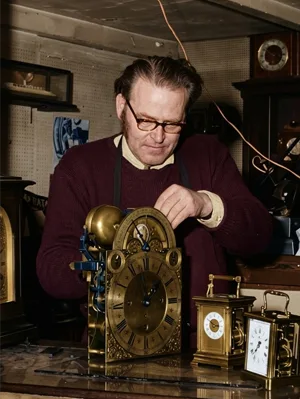
Ernest Gordon Roland Lee - known to friends, family, and customers simply as Gordon - was born in Eastbourne, Sussex, on March 27, 1926. He was the son of George William Lee (1897–1969) and Winifred Jane Baker (1897–1974).
His early life saw him navigating the challenges of the pre-war era; by the outbreak of the Second World War in September 1939, a 13-year-old Gordon was recorded as residing at the Newhaven Public Assistance Institute and Infirmary (Hill House) in Newhaven, where he was noted as incapacitated.
By the post-war reconstruction era of the late 1940s, a resilient Gordon had returned to his hometown. Between 1947 and 1950, electoral registers place him living at 8 Wharf Road, Eastbourne, a period that marked his transition into adulthood and the beginning of his own family.
Marriage and Move along the Coast The year 1950 was a milestone for Gordon. On September 30, he married Denise Peggy Blanch Budgen (1930–2006) in the idyllic village of Berwick, Sussex.
Shortly after their marriage, the couple relocated westward along the south coast to the Havant, Portsmouth and Gosport area of Hampshire. This move likely coincided with Gordon’s growing career opportunities and his deep affinity for maritime life. Together, Gordon and Denise raised a bustling family of five children born over a ten-year span.
The Master Clocksmith of "The Time House" By the early 1970s, Gordon had firmly established himself as a master horologist. He operated his own boutique shop, The Time House, located in a historic pocket of Havant, Hampshire known as The Pallant.
As highlighted in the June 1972 profile in The News Extra, Gordon was celebrated as part of "a dying breed of craftsmen" standing defiant against a modern world of computerised, mass-produced, and "stuck together with glue" timepieces. He was a fierce critic of what he called "planned obsolescence," passionately believing that a well-crafted clock should easily outlast a century.
His daily life was entirely consumed by his craft:
The Workshop: He specialized in high-end, complex restorations, handling incredibly rare pieces such as an English bracket verge musical clock from 1770 and French carriage repeaters.
The Fixer of Mistakes: He frequently found himself "working miracles," rescuing delicate antique movements that had been entirely dismantled and brought to him in bags by well-meaning "enthusiastic amateurs."
International Reputation: Though his shop was small, his expertise was known worldwide. By 1972, he was regularly drawing tracking business and elite clientele from France, Germany, and Canada.
Ships, Sails, and the Naval Connection Outside of the ticking of pendulums, Gordon’s great passion was the sea. The Time House was just as much a maritime museum as it was a clock shop, its walls adorned with intricate ship models and historic photographs of great vessels.
Living and working so close to the Portsmouth naval hub, his hobby beautifully intertwined with his business. Local naval servicemen frequently visited his shop, bringing him historic photographs and maritime artifacts in exchange for his promise to meticulously mend their own clocks. These interactions provided Gordon with a steady stream of "interesting chats" about naval history, a subject close to his heart.
Final Years Gordon spent decades preserving the history of others through his meticulous work on centuries-old timepieces. After a long career in Hampshire, he eventually returned full circle to his birth town. He passed away in Eastbourne on June 1, 1991, at the age of 65, and was cremated at the Eastbourne Crematorium, leaving behind a legacy of dedicated craftsmanship, family, and a lifelong love for the south coast's maritime heritage.