
A Generation Broken:
The Life, Trade, and Tragic Loss of the Funnell Brothers
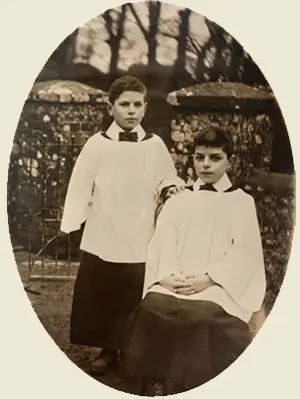 The fabric of small rural communities is woven tightly from shared ancestry, local trade, and the quiet rhythm of generations occupying the same patches of earth. In the early decades of the twentieth century, the parish of Berwick and the neighbouring village of Ripe, nestled under the chalk escarpments of the South Downs in Sussex.
For Horace Funnell Sr. and his wife Elsie Edith (née Budgen), residing at The Hermitage near Berwick Station, life was anchored by the honest, physically demanding craft of bricklaying. Horace Sr., born in Hellingly on January 26, 1874, had worked the Sussex earth his entire life. He started as a seven-year-old schoolboy in Chalvington before stepping into the fields as a teenage agricultural laborer. By the turn of the century, however, he had mastered a specialised trade, registering as a journeyman bricklayer.
When he settled his family on Ripe Street, Horace Sr. found long-term, stable employment with Alfred Pettit of Alfriston, the prominent local builder and contractor whose firm shaped much of the interwar architecture of the Cuckmere Valley. It was a rigorous, respected craft that Horace Sr. proudly passed down to his boys, who would both enter the building trade under the same local banner.
Yet, the very tightness of these rural neighborhoods meant that when tragedy struck a single household, the ripples of grief were felt across the entire district. For the Funnell family, the interwar period brought an almost unfathomable burden of loss. Within the span of just thirty-one months, Horace Sr. and Elsie were forced to bury two of their young sons: Denis Hector Funnell and Horace Randall Funnell. These young men, who worked the same local scaffolding, walked the very same paths of childhood, and looked forward to the promise of the 1930s, were cut down in their prime. Their untimely passings left a permanent shadow over The Hermitage.
Part I: The Common Path on Ripe Street
Born three years apart - Horace Randall on April 8, 1907, and Denis Hector on March 14, 1910—the boys grew up side-by-side in a cozy cottage on Ripe Street. Their lives were beautifully synchronized by the traditions of the rural church. Both brothers were raised with a deep connection to St. John the Baptist Church in Ripe, where their father had been confirmed as a fifteen-year-old boy back in 1889. Horace Randall was baptized there on August 4, 1907, and Denis followed in April 1910. As they grew, Denis became a cornerstone of the village church choir, his voice a familiar, uplifting comfort to the congregation.
The defining spiritual milestone of their youth occurred on November 25, 1922. On that chilly winter day, fifteen-year-old Horace Randall and twelve-year-old Denis walked side-by-side up the aisle of the Ripe parish church. Kneeling together before the visiting bishop, the two brothers received their Confirmation during the very same service.
As they stepped out of school and into adulthood, both boys followed their father onto the building sites of Alfred Pettit's firm. Denis took up employment as a bricklayer's laborer before choosing a different path at sea. Meanwhile, Horace Randall advanced as a dedicated bricklayer's laborer for Alfred Pettit, working directly under the Alfriston-based firm. He lent his physical strength to regional building contracts—mixing mortar, moving scaffolding, and carrying heavy loads of Sussex clay brick alongside his father. Rather than running an independent business, they were proud, skilled tradesmen working for one of the region's most established contractors.
Part II: The First Loss – Denis Hector Funnell (March 1929)
As the 1920s drew to a close, the family shifted their residence a few miles south from Ripe Street to a home known as The Hermitage, situated near Berwick Station. From this new base, the youngest son, Denis, began to look beyond the boundaries of the Sussex brick yards. On January 28, 1929, having recently celebrated his eighteenth year, Denis enlisted for service in the Royal Navy, receiving the service number Kx 79703. He was dispatched to Portsmouth and stationed at Gosport for his initial training, formally attached to the shore establishment Victory II.
Yet, the greatest danger facing a new recruit in the interwar military was not naval warfare, but the crowded stone barracks where infectious diseases thrived. In early March 1929, a mere six weeks after he had proudly signed his enlistment papers, Denis contracted Cerebrospinal Meningitis, known then as "spotted fever." He was admitted to the Haslar Royal Naval Hospital in Gosport on March 11, 1929. Denis fought the agonizing illness for just four days, passing away on Friday, March 15, 1929—exactly one day after he had marked his nineteenth birthday on his hospital bed.
Denis’s body was conveyed by rail back to the familiar platform of Berwick Station. On Monday, March 18, 1929, the village came to a standstill as Denis was escorted to St. Michael & All Angels Church Graveyard in Berwick for his burial. The service was led by the Rector of Berwick, the Rev. A. E. Roe, assisted by the Rev. F. R. Fox, the clergyman from Ripe who had known Denis since his choir boy days. Standing by the open grave were his devastated parents, his siblings, and an extensive network of extended family. A sprawling array of floral tributes was left at the graveside by his childhood friends and fellow vocalists from the Ripe church choir.
Part III: The Practical Visionary – Horace Randall Funnell (October 1931)
With Denis laid to rest, the family at The Hermitage focused their remaining energy on their daily work, with Horace Randall continuing his employment as a bricklayer's laborer under Alfred Pettit. Horace Randall required speed and independence, which he found in the ultimate symbol of interwar mobility: the motorcycle.
Horace Randall had lived just over two and a half years without his younger brother when his own final journey arrived on the evening of Monday, October 26, 1931. At approximately 6:34 p.m., Horace Randall was riding his motorcycle along the main road toward Eastbourne at a perfectly safe, moderate speed. Ahead of him chugged a massive, six-wheeled steam lorry owned by Mr. F. Avann, a prominent Eastbourne merchant.
The tragedy unfolded within the parish boundary of Willingdon, on the steady, demanding incline of Waghorn Hill. As the heavy steam wagon labored its way up the slope, its coal-fired engine exhaled a dense, low-lying, and expanding plume of thick black smoke and condensed white steam. In the cool evening air, this heavy vapor did not dissipate; instead, it settled over the asphalt like an impenetrable wall of artificial fog.
Horace Randall rode directly into this localised whiteout. Blinded by the sudden vapor, he had no warning that the slow-moving rear of the steam wagon was directly in his path. The motorcycle struck the back of the lorry with immense force, becoming tightly wedged beneath the chassis. Horace Randall was thrown violently onto the hard road, causing an instantaneous, fatal fracture to his skull.
The subsequent inquest at Polegate focused intently on the environmental hazards of steam-powered haulage. Ultimately, the jury returned a verdict of "Accidental death," explicitly exonerating the lorry driver from any blame. On Friday, October 30, 1931, Horace Randall was carried into St. Michael & All Angels Church Graveyard, laid to rest in the very same soil as his brother Denis.
Part IV: The Long Shadow Over The Hermitage
For Horace Funnell Sr., the loss of Horace Randall was a shattering blow that dismantled the generational continuity of his life's work. By the end of October 1931, the two sons who had shared his craft under Alfred Pettit, worked alongside him on the local scaffolding, and carried his name were both gone.The sheer volume of family losses endured by Horace Sr. and Elsie during their lives illustrates the profound resilience required of their generation:
Horace Sr. lived for another eight years at The Hermitage, continuing to work his trade for Pettit's firm in a world that undoubtedly felt far too quiet. He finally laid down his tools permanently on June 19, 1939, passing away at the age of sixty-five. He was buried three days later, returning to the Berwick churchyard to join his two boys in their eternal rest. He slipped away just three months before Europe was plunged into the total chaos of the Second World War. His beloved wife, Elsie, survived him by nearly two decades, carrying the heavy, proud memories of her husband and her boys until her passing in 1957.
Part V: Conclusion
The combined narrative of the Funnell family stands as an enduring monument to the quiet dignity and resilience of the working-class people of the Cuckmere Valley. They were the builders who physically shaped the villages, working steadily under employers like Alfred Pettit to lay the foundations of the community. Despite having their hearts torn out twice in less than three years, Horace Sr. and Elsie ensured their sons were honored, remembered, and laid to rest with the ultimate respect by the neighbors who had worked alongside them.