
John Francis Budd (1894–1979)
From Sussex Cyclist to Prisoner of War
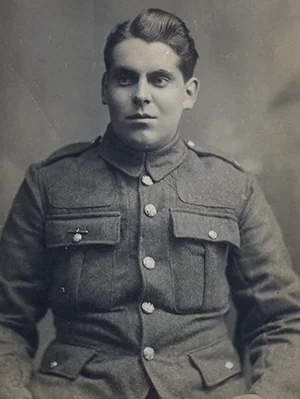 Service Overview
- Full Name: John Francis Budd
- Date of Birth: 9 November 1894
- Enlistment Date: 11 December 1915 (Attested) | 1 December 1916 (Mobilized)
- Place of Enlistment: Eastbourne, Sussex (Attestation) | Chichester, Sussex (Mobilization Depot)
- Regimental Numbers: 30428 & 241940 (Royal Sussex Regiment) | 124317 (Machine Gun Corps)
- Highest Rank: Private
- Theatres of War: Home Front (1915–1917), Western Front (France/Flanders, 1917–1918)
- Status: Prisoner of War (Captured 21 March 1918, Repatriated 27 November 1918)
Detailed Timeline of Military Career
1. Enlistment & The Derby Scheme (December 1915)
John Francis Budd officially entered military service on 11 December 1915 by signing his attestation papers at a local recruitment center in Eastbourne. He volunteered under the Derby Scheme (Group System), a final national effort to secure voluntary commitments before full conscription was introduced. Under this system, John took the oath of allegiance, was paid a day's token army pay, and was deferred to the Army Reserve until his specific age and marital group was called up for active service.
2. Mobilisation & Coastal Defence (December 1916 – Late 1917)
On 1 December 1916, as frontline losses demanded fresh reinforcements, John was officially mobilised. He was ordered to report to the ancestral home of the county regiment: Roussillon Barracks in Chichester. As the primary Regimental Depot for the Royal Sussex Regiment, Chichester acted as his processing centre for medical exams, uniform allocation, and initial training.
He was assigned to the 6th (Cyclist) Battalion, Royal Sussex Regiment and issued his original regimental service number: 30428.
The 1917 Territorial Renumbering: > In March 1917, the War Office systematically overhauled the numbering of all Territorial Force units to eliminate administrative confusion. John’s original 5-digit number (30428) was retired, and he was issued a new, permanent 6-digit number within the 6th Battalion's designated block: 241940.
The 6th Battalion was a mobile bicycle infantry unit. Stripped of heavy marching packs and mounted on standard-issue military bicycles, these troops were highly mobile coast-watchers. Throughout 1916 and 1917, John was deployed along the vulnerable coastlines of Norfolk, Kent, and Essex. Their primary directive was Home Defence: patrolling coastal roads against potential German naval raids, guarding vital infrastructure, and acting as rapid-response units during enemy Zeppelin air raids.
3. Transfer to the Machine Gun Corps (Late 1917)
As the stalemate on the Western Front evolved, tactical doctrine shifted toward concentrated mechanical firepower. The British Army centralized its heavy weaponry by transferring men into the specialized Machine Gun Corps (MGC). Because these teams were designated high-priority targets and held the absolute apex of forward defensive lines, the corps suffered heavy casualties, earning the grim moniker "The Suicide Club."
John was selected for this technical branch, receiving a new MGC service number: 124317. He was sent to the massive MGC training centre at Belton Park near Grantham, Lincolnshire, where he transitioned from standard rifle tactics to specialized ballistic training. He mastered the Vickers .303 Medium Machine Gun—learning how to clear mechanical jams in darkness, manage water-cooling jackets under prolonged fire, and calculate complex indirect fire patterns over the heads of advancing friendly troops.
Upon completing his training, he was deployed to France in late 1917, joining the 61st Battalion, Machine Gun Corps (attached to the 61st [2nd South Midland] Division).
4. The Spring Offensive & Capture at St. Quentin (March 1918)
By March 1918, the 61st Battalion MGC was positioned in the forward defensive lines northwest of St. Quentin, holding a thin, extended sector of the British Fifth Army's front line.
At 4:40 AM on the foggy morning of 21 March 1918, the German Army launched Operation Michael (the German Spring Offensive). The assault opened with an unprecedented five-hour artillery bombardment of 3.5 million shells mixed with mustard and phosgene gas.
Favoured by a dense morning fog, elite German Stoßtruppen (Stormtroopers) bypassed the primary British redoubts. The machine gun teams of the 61st Battalion fought desperately, firing blind into the mist until their positions were entirely isolated. Ordered to hold the line to buy time for rear defence lines to organise, John's unit was cut off, surrounded, and overrun. Private John Budd was officially reported Missing in Action on 21 March 1918.
5. Captivity at Lager Stendal (March – November 1918)
International Red Cross and German military tracking records confirmed that John survived the initial onslaught and was taken as a Prisoner of War (POW) at St. Quentin.
He was processed through frontline collection points and transported by rail deep into the German interior to Lager Stendal, a major Mannschaftslager (Enlisted Men's Camp) located in Saxony-Anhalt, northeast of Magdeburg.
While officers were held in separate camps, enlisted men like John were utilised for labour. He was assigned to an Arbeitskommando (working detachment), performing hard labour in regional agriculture, factories, or rail yards. Because the Royal Navy's maritime blockade caused severe domestic food shortages across Germany, prisoners survived on meagre rations of sawdust-blended black bread and thin turnip soup, relying heavily on British Red Cross parcels for vital sustenance.
6. Repatriation & Demobilisation (1918–1919)
Following the collapse of the German war effort and the signing of the Armistice on 11 November 1918, camp infrastructure dissolved. John was swiftly evacuated and arrived back on British soil on 27 November 1918, just over two weeks after hostilities ceased.
Following medical clearances to evaluate the physical impact of combat and months of enemy captivity, he was granted hyper-mobilization leave to return home to Sussex. On 5 March 1919, John was formally transferred to the Class "Z" Army Reserve. This allowed him to return permanently to civilian life and his profession, while remaining liable to be recalled to the colours if Germany breached the armistice terms prior to the final peace treaty.
Campaign Medals and Awards
For his active service in the face of the enemy on the Western Front, Private John Francis Budd was awarded the definitive campaign medals of the Great War:
The British War Medal: Awarded for service overseas in an active theatre of war.
The Victory Medal: Awarded to all personnel who entered a theatre of active operations against the Central Powers between 1914 and 1918.
Both medals were struck and officially recorded under his final Machine Gun Corps details (recorded on Roll: MGC/101 B19, Page 1974), serving as a permanent testament to his journey from volunteer enlistment in Eastbourne, through coastal bicycle patrols, to the sharp end of the Great War's largest German offensive.