
Herbert John Budgen (1901–1958)
The Life of Chief Petty Officer
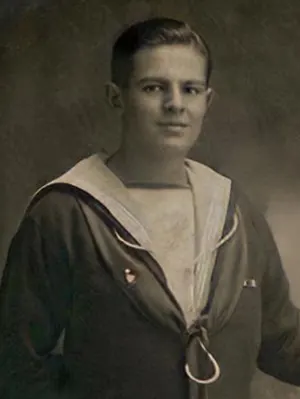 The history of the Royal Navy is often told through the lens of admirals and dreadnoughts, but the true backbone of the "Senior Service" has always been its career sailors—men who dedicated decades to the rhythm of the tides and the discipline of the deck. Herbert John Budgen was one such man. His life was a remarkable journey that began in the rural quiet of Edwardian Sussex, weathered the storms of two World Wars, and saw him rise from an uncertain, illegitimate beginning to the senior-most non-commissioned rank in the Navy.
This is the story of a man who balanced a life of high-seas adventure with a profound commitment to his family, eventually returning to the very soil from which he sprang.
The Early Years: A Sussex Boyhood (1901–1918)
Herbert John Budgen was born on March 5, 1901, at the Old Toll Gate (part of the Laughton Lodge estate) in Laughton, East Sussex. His entry into the world was marked by the social complexities of the era; he was born "illegitimate" to Elsie Edith Budgen, a twenty-one-year-old local woman. In the rigid social structure of the early 1900s, this status often carried a heavy stigma, yet it served as the catalyst for Herbert’s unique identity.
While his mother eventually formed a lasting union with Horace Funnell, and Herbert grew up surrounded by siblings—Elsie, Horace, Dennis, and Clara—who all bore the Funnell name, Herbert remained a Budgen. He was raised in the village of Ripe, listed in the 1911 Census as a "Son" in the Funnell household, but the retention of his mother’s maiden name was a permanent link to his individual origin. This duality—living as a Funnell but officially recognized as a Budgen—perhaps instilled in him the resilience and self-reliance that would later define his naval career.
Growing up in the Sussex countryside, Herbert’s world was one of agricultural labor and village tradition. However, the horizon was changing. By the time he was thirteen, the world was at war. For a young man in a landlocked village, the Royal Navy offered not just a way to serve the King, but a trade, a steady wage, and an escape into a wider world.
Joining the Senior Service: The Great War and the Apprentice (1918–1925)
On August 1, 1918, just months before the Armistice, seventeen-year-old Herbert took the King’s Shilling. His service records show he began his journey as a Boy 2nd Class aboard HMS Powerful, a protected cruiser that had been converted into a training ship. At 5’4” with a fresh complexion and light brown hair, he was a typical "Sussex lad" entering the iron world of the Navy.
Herbert was assigned to the Catering Branch. While Hollywood focuses on gunners and pilots, the Navy knew then—as it does now—that a ship’s fighting spirit depends entirely on its stomach. Herbert’s early years were spent in the grueling "Trial by Fire" of coal-fired galleys. He served on various ships and shore stations, including HMS Research and the seaplane base HMS Sarepta.
By the early 1920s, Herbert had transitioned from a "Boy" to a "Cook." Returning to Ripe Street on leave in 1921, he would have appeared to his neighbors as a transformed man. He had seen the coastlines of Europe and mastered the complex logistics of the "General Messing" system, a new professional standard that replaced the old, disorganized way sailors used to feed themselves.
The Professional Ascent and a Portsmouth Romance (1926–1938)
The mid-1920s were a turning point for Herbert. His skill in the galley was recognized with a promotion to Leading Cook in 1926. That same year, he anchored his personal life by marrying Eleanor Ida Jane Ventham on December 27 at St. Paul’s Parish Church in Portsmouth. Eleanor, born in 1904, was a "Portsmouth girl," well-acquainted with the sacrifices required of a Navy wife.
The young couple settled in the heart of the naval community, living at 32 King Street in Southsea. For Herbert, the 1930s were a decade of intense professional development. He served at HMS Excellent, the Navy’s premier gunnery school at Whale Island. Here, the standards were the highest in the fleet; a cook at Excellent was expected to provide service that matched the precision of the Navy’s biggest guns.
By 1935, Herbert was promoted to Petty Officer (Cook) and joined the crew of HMS Vanoc, a V-class destroyer. Life on a destroyer was notoriously difficult. These "greyhounds of the sea" were fast, but they pitched and rolled violently in the Atlantic swells. As the PO Cook, Herbert was responsible for feeding 150 men while the floor of his galley was often at a 30-degree angle. It was during these years that his daughters Denise (b. 1930) and Joan (b. 1932) were born, beginning their lives in the salt-air of Portsmouth.
However, life was not without tragedy. Between 1929 and 1931, Herbert lost both of his younger brothers, Dennis and Horace Randall Funnell, both at tragically young ages. As the eldest, Herbert became a pillar of strength for his mother, Elsie, even as his own career took him further out to sea.
World War II: The Move to Berwick and the "Erebus" (1939–1945)
When war was declared in September 1939, Herbert was at the height of his powers. In 1940, he reached the prestigious rank of Chief Petty Officer (Cook). This was the pinnacle of the non-commissioned catering branch. He was no longer just cooking; he was a manager of men, a master of victualling, and a senior leader aboard a warship.
His wartime assignment was to HMS Erebus, a massive monitor ship carrying two 15-inch guns designed for coastal bombardment. The Erebus was a prime target and saw heavy action, including the invasion of Sicily and the Normandy landings.
While Herbert faced the dangers of the Mediterranean and the English Channel, he faced a difficult choice at home. Portsmouth was under heavy bombardment from the Luftwaffe. The docks, where Herbert had spent so much of his career, were being leveled. In a decisive move to protect his family, Herbert moved Eleanor and the girls out of Portsmouth.
They returned to Herbert’s Sussex roots, initially moving into The Hermitage in Berwick to live with his mother, Elsie. This multi-generational home provided a safety net for Eleanor, who was pregnant with their third child. However, Herbert wanted his family to have their own "quarter deck." A few months later, they moved just across the road to a rented house at 11 Downsway. It was here, in the relative safety of the Sussex Downs, that his third daughter, Barbara May, was born on August 1, 1940.
For the remainder of the war, 11 Downsway was the "home port" Herbert dreamed of while serving on the Erebus. His service records show an impeccable character rating of "Very Good" and an ability rated as "Super." He was awarded a litany of medals for his service, including the 1939-1945 Star, the Atlantic Star, the Italy Star, the Burma Star, and the Defence Medal.
The Final Chapter: The Pastry Cook of Berwick (1945–1958)
Herbert was released from service on September 13, 1945, having served for a staggering 27 years, 1 month, and 12 days. He returned to Berwick not as a retired old man, but as a master of his craft.
The transition from Chief Petty Officer to civilian life saw him take up work as a Pastry Cook. In the naval hierarchy, the pastry cook was the "artist" of the galley—the one with the steady hand and the patience for detail. He spent his final years in the quiet village of Berwick, living at 11 Downsway, the house he had secured for his family during the dark days of 1940.
The end of his life came quickly. In December 1957, his mother, Elsie Edith, passed away at the age of 77. Herbert followed her just a month later. He passed away on January 25, 1958, at St. Mary’s Hospital in Eastbourne. The cause of death—lung cancer that had spread to the brain—was likely a lingering cost of a lifetime spent in the smokey, poorly ventilated galleys of early 20th-century warships.
He was buried on January 29, 1958, in Berwick. He had come full circle: from a boy born at the Laughton Toll Gate to a highly decorated Chief Petty Officer who chose to spend his final days in the very same Sussex countryside.
Medals and Honors
Herbert’s chest was a map of the British Empire’s struggles and victories. His medals included:
British War Medal (WWI)
1939–1945 Star
Atlantic Star
Burma Star
Italy Star
Defence Medal
War Medal 1939–1945
Long Service and Good Conduct Medal (Awarded 1934)
Legacy
Herbert John Budgen left behind a legacy of discipline, care, and survival. He rose above the circumstances of his birth to become a leader of men in the world's most powerful navy. He protected his family when it mattered most, moving them from the fires of the Portsmouth Blitz to the safety of 11 Downsway. He remains a testament to the Sussex spirit—sturdy, reliable, and "wun't be druv."
To his family, he was a beloved father and "Grandad." To history, he is a Chief Petty Officer of the Royal Navy who did his duty until the very end.
"A life spent at sea, a heart stayed at home."